
Have you ever needed to return more than one value from a function in Python? This is a common requirement for Python developers, and Python makes it incredibly easy. In this tutorial, I will explain how to return multiple values from a function in Python with examples.
To return multiple values from a function in Python, simply separate them with commas in the return statement. This creates a tuple, which you can then unpack or use directly. For example, def get_coordinates(): return 10, 20 will return (10, 20), allowing you to handle multiple pieces of data efficiently.
Return Multiple Values from a Function in Python
There will be many scenarios where you need to return multiple values from a Python function. There are various ways to do this, from the basic to the advanced.
Basic Syntax
In Python, you can return multiple values from a function by simply separating them with commas in the return statement. These values are returned as a tuple. Here’s a basic example that returns two values from the Python function.
def get_coordinates():
    x = 10
    y = 20
    return x, y

coordinates = get_coordinates()
print(coordinates)  # Output: (10, 20)
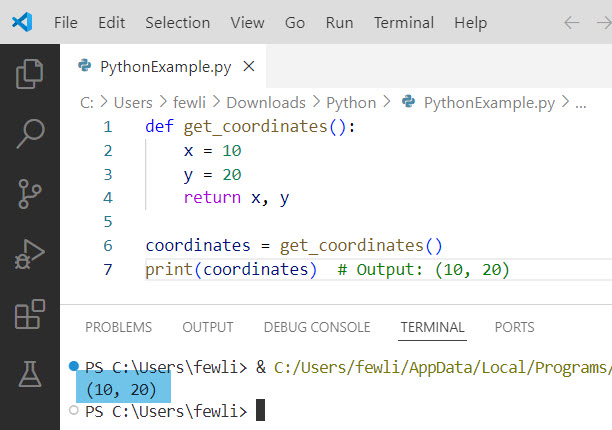
In this example, the get_coordinates function returns two values, x and y, which are then captured as a tuple. Here is the output in the screenshot below:
Check out How to Call a Function in Python?
Using Tuples
Tuples are another way to return multiple values from a Python function. When you separate values with commas in the return statement, Python automatically packs them into a tuple.
def calculate_area_and_perimeter(length, width):
    area = length * width
    perimeter = 2 * (length + width)
    return area, perimeter

result = calculate_area_and_perimeter(5, 3)
print(result)  # Output: (15, 16)
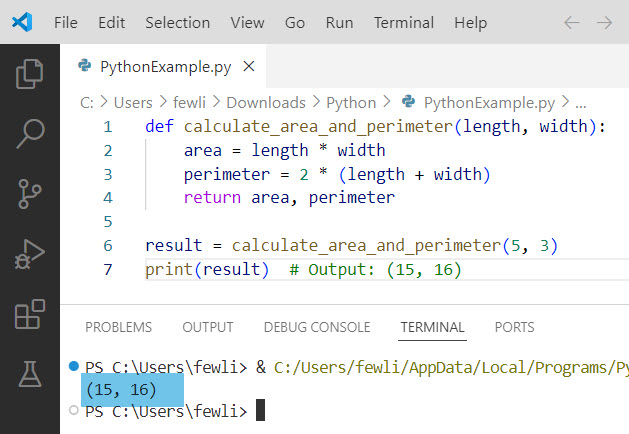
In this example, the function calculate_area_and_perimeter returns both the area and the perimeter of a rectangle.
Here is the output in the screenshot below:
Using Lists
If you prefer, you can also return multiple values as a list. This can be useful if you need a mutable collection of values. Here is another example of returning multiple values as a list from a function in Python.
def get_even_numbers(n):
    evens = [i for i in range(n) if i % 2 == 0]
    total = len(evens)
    return [evens, total]

result = get_even_numbers(10)
print(result)  # Output: [[0, 2, 4, 6, 8], 5]
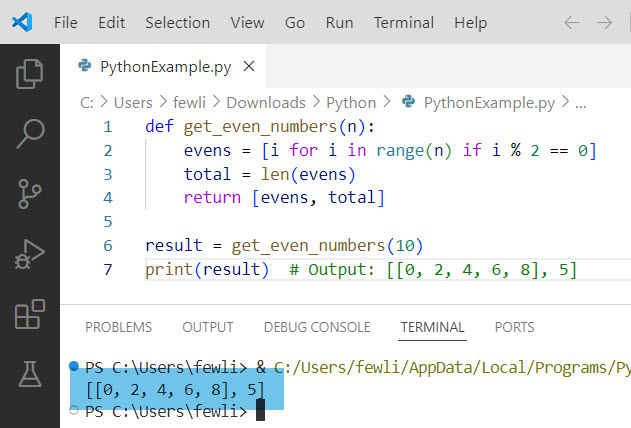
Here, the function get_even_numbers returns a list of even numbers up to n and the total count of those numbers.
Here is the output in the screenshot below:
Check out Python Function Examples with Parameters
Using Dictionaries
Dictionaries are another excellent way to return multiple values from a Python function, especially when you want to label each value for clarity.
Here is an example and the complete code.
def get_user_info():
    user = {
        "name": "John Doe",
        "age": 30,
        "email": "john.doe@example.com"
    }
    return user

user_info = get_user_info()
print(user_info)  # Output: {'name': 'John Doe', 'age': 30, 'email': 'john.doe@example.com'}
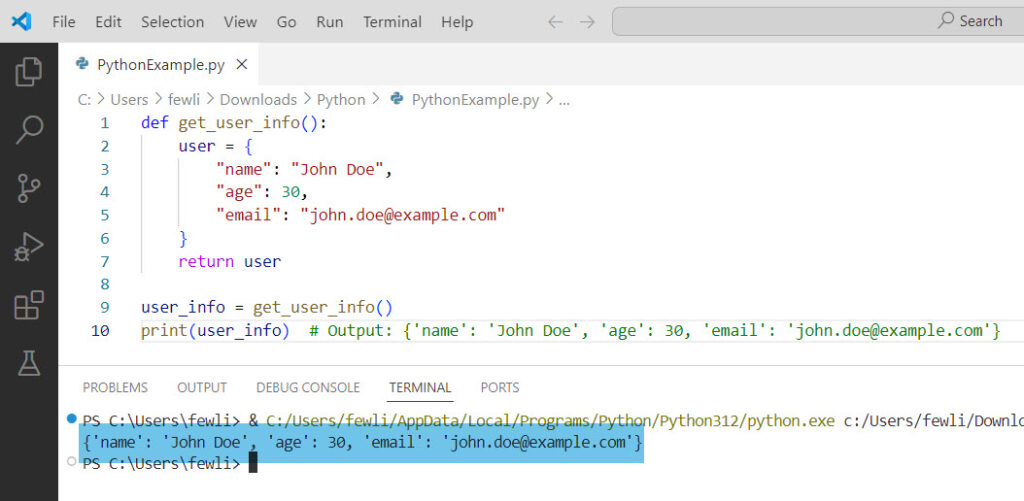
In this example, the function get_user_info returns a dictionary containing user information.
You can see the exact output in the screenshot below.
Using Named Tuples
Named tuples offer a way to return multiple values with more readability and structure. Here is another example of returning multiple values from a Python function.
from collections import namedtuple

def get_point():
    Point = namedtuple('Point', 'x y')
    return Point(10, 20)

point = get_point()
print(point)  # Output: Point(x=10, y=20)
print(point.x, point.y)  # Output: 10 20
Here, the get_point function returns a named tuple, which makes accessing the values more intuitive.
Check out Python Function Naming Conventions
Python Function Return Multiple Values – Examples
Now, let me show you a few real examples of returning multiple values from a function in Python.
Scenario 1: Returning Multiple Calculations
Imagine you’re building a financial application and need to calculate both the interest and the total amount for a given principal, rate, and time. Here is an example.
def calculate_interest(principal, rate, time):
    interest = (principal * rate * time) / 100
    total_amount = principal + interest
    return interest, total_amount

interest, total_amount = calculate_interest(1000, 5, 2)
print(f"Interest: {interest}, Total Amount: {total_amount}")
# Output: Interest: 100.0, Total Amount: 1100.0
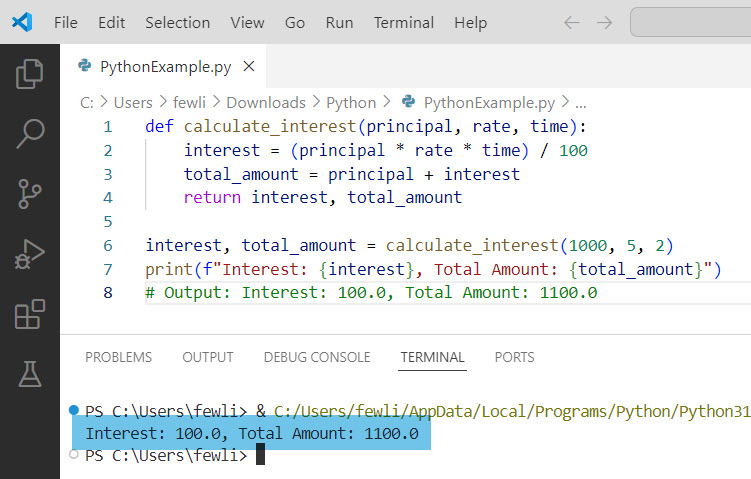
If you will execute the above Python code, you can see the output in the screenshot below:
Scenario 2: Data Processing
Let me show you another real example of returning multiple values from a function in Python.
In data analysis, you might need to return both the processed data and some statistics about the data.
def process_data(data):
    processed_data = [d * 2 for d in data]
    data_sum = sum(processed_data)
    data_count = len(processed_data)
    return processed_data, data_sum, data_count

data = [1, 2, 3, 4, 5]
processed_data, data_sum, data_count = process_data(data)
print(f"Processed Data: {processed_data}, Sum: {data_sum}, Count: {data_count}")
# Output: Processed Data: [2, 4, 6, 8, 10], Sum: 30, Count: 5
Scenario 3: User Authentication
In a web application, you might need to return both the authentication status and the user profile. Here is an example and the complete Python code.
def authenticate_user(username, password):
    if username == "admin" and password == "secret":
        return True, {"username": "admin", "role": "administrator"}
    else:
        return False, {}

is_authenticated, user_profile = authenticate_user("admin", "secret")
print(f"Authenticated: {is_authenticated}, User Profile: {user_profile}")
# Output: Authenticated: True, User Profile: {'username': 'admin', 'role': 'administrator'}
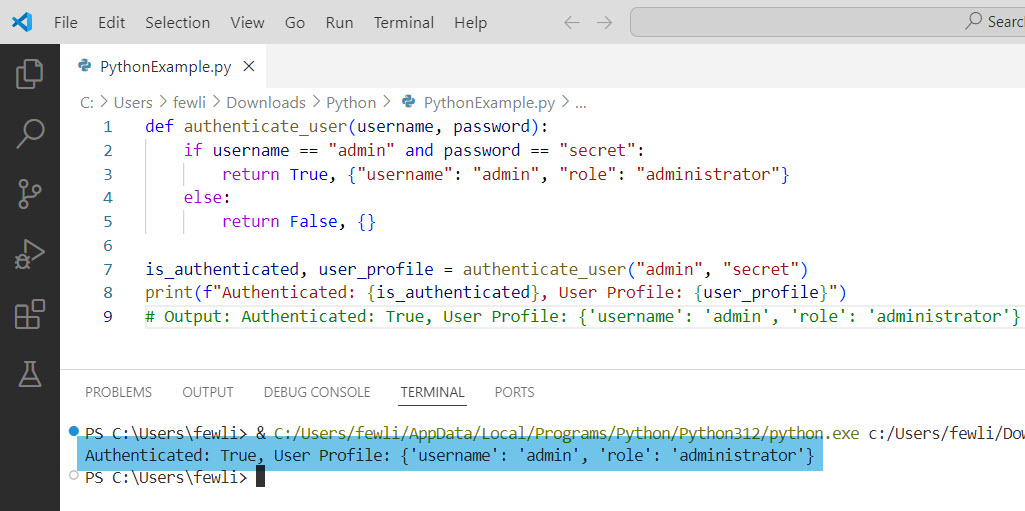
Here is the output in the screenshot below:
Conclusion
In this tutorial, I have explained how to return multiple values from a function in Python using tuples, lists, dictionaries, named tuples, etc. We also saw different real examples of returning multiple values from Python functions.
You may also like:
- How to Call a Function by String in Python?
- How to Call the Main Function in Python?
- Run a Python Function from the Command Line

I’m Michelle Gallagher, a Senior Python Developer at Lumenalta based in New York, United States. I have over nine years of experience in the field of Python development, machine learning, and artificial intelligence. My expertise lies in Python and its extensive ecosystem of libraries and frameworks. Throughout my career, I’ve had the pleasure of working on a variety of projects that have leveraged my skills in Python and machine learning. Read more…