
Recently, we were working on a shopping cart application in Python, and we were required to do some multiplication. In this tutorial, I will show you how to multiply a variable in Python using different methods and examples.
To multiply variables in Python, you simply use the * operator. For example, if you have two variables, a = 5 and b = 3, you can multiply them by writing result = a * b. This will store the product of a and b in the variable result, which in this case would be 15.
Multiply a Variable in Python
Now, let me show you how to multiply a variable in Python using different methods and examples.
1. Basic Multiplication
The best way to multiply numbers in Python is by using the * operator. Here’s a simple example:
# Basic multiplication
result = 5 * 3
print(result)  # Output: 15
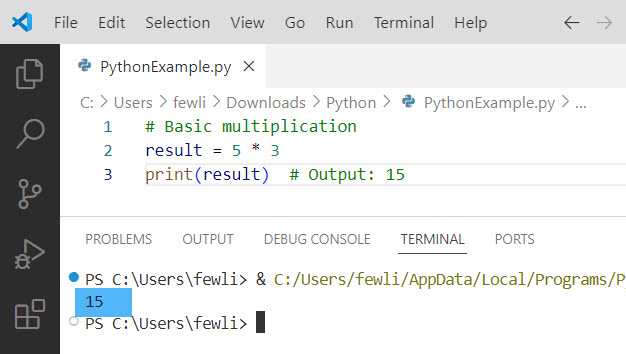
This example demonstrates how to multiply two integers in Python directly. I executed the Python code, and you can see the output in the screenshot below:
Check out How to Increment a Variable in Python?
2. Multiply Variables
Often, you’ll need to multiply variables rather than hard-coded numbers. So, in those cases, we need to multiply variables in Python. Let’s look at an example of calculating the total price of items in a shopping cart.
# Multiplying variables
price_per_item = 20
quantity = 3
total_price = price_per_item * quantity
print(total_price)  # Output: 60
In this example, price_per_item and quantity are variables that store the price of a single item and the number of items, respectively. We multiply these variables to find the total price.
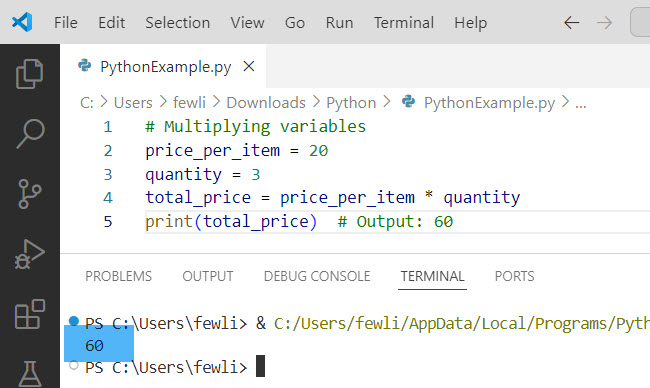
You can also see the exact output in the screenshot below:
3. Using the math Module
While the * operator is sufficient for basic multiplication, Python’s math module offers additional functionality for more complex mathematical operations. However, for multiplication, the * operator is generally preferred. Here’s an example for this:
import math

# Using math.prod for multiplying elements in an iterable (Python 3.8+)
numbers = [2, 3, 4]
product = math.prod(numbers)
print(product)  # Output: 24
Check out How to Subtract from a Variable in Python?
4. Multiply Lists
Now, let me show you how to multiply lists in Python.
Multiplying elements in a list requires a different approach. You can use a loop or the functools.reduce function with operator.mul. Here’s how:
from functools import reduce
import operator

numbers = [2, 3, 4]
product = reduce(operator.mul, numbers, 1)
print(product)  # Output: 24
This method efficiently multiplies all elements in the list.
5. Multiply Matrices
Matrix multiplication is a bit more complex and typically requires the use of libraries such as NumPy. Here’s an example using NumPy:
import numpy as np

# Define two matrices
matrix_a = np.array([[1, 2], [3, 4]])
matrix_b = np.array([[5, 6], [7, 8]])

# Multiply matrices
result = np.dot(matrix_a, matrix_b)
print(result)
# Output:
# [[19 22]
#  [43 50]]
This example explains how to perform matrix multiplication using the np.dot function from the NumPy library.
Read Divide a Variable in Python
Practical Example: Multiply Variables in Python
Now, let me give you a real-time example of how to multiply variables in Python. Here, I will show you how to calculate the total cost.
Example: Calculate Total Cost
Suppose you’re developing a shopping application for a grocery store in New York. You need to calculate the total cost of apples and oranges in a customer’s cart.
# Prices in dollars
price_per_apple = 1.5
price_per_orange = 2.0

# Quantities
num_apples = 4
num_oranges = 3

# Total cost
total_cost = (price_per_apple * num_apples) + (price_per_orange * num_oranges)
print(total_cost)  # Output: 12.0
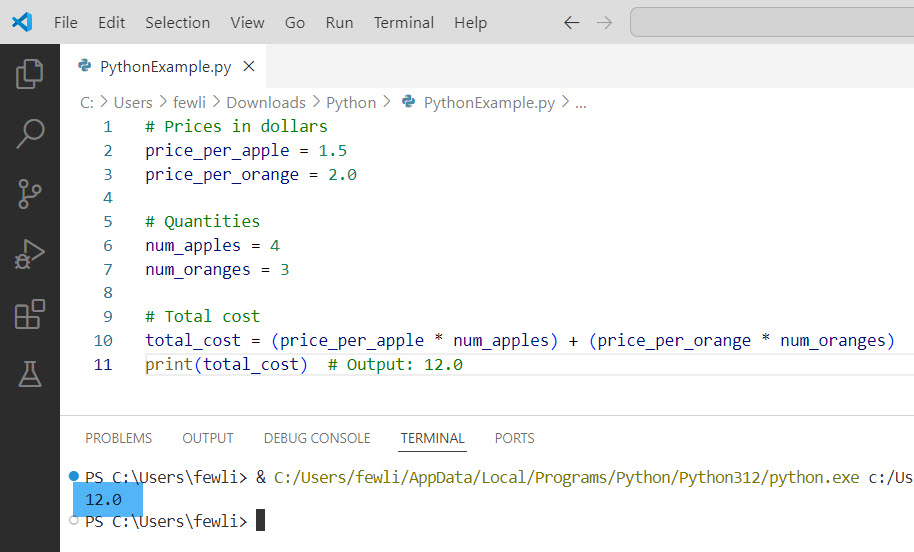
I executed the above Python code, and you can see the exact output in the screenshot below:
Conclusion
In this tutorial, I explained how to multiply a variable in Python using different methods like basic multiplication, multiplying variables, using the math module, multiplying lists, and matrix multiplication with NumPy. I hope the practical example also helps you to know how to multiply variables in Python.
You may also like:

I’m Michelle Gallagher, a Senior Python Developer at Lumenalta based in New York, United States. I have over nine years of experience in the field of Python development, machine learning, and artificial intelligence. My expertise lies in Python and its extensive ecosystem of libraries and frameworks. Throughout my career, I’ve had the pleasure of working on a variety of projects that have leveraged my skills in Python and machine learning. Read more…