
Today, in the New York Python user group, one member asked about repeating a function in Python. This is a little tricky, but there are different methods. In this tutorial, I will explain how to repeat a function in Python using various methods and examples.
To repeat a function in Python using a for loop, you simply define the function and then use the loop to call it multiple times. For example, if you have a function greet() that prints “Hello, World!”, you can repeat it 5 times with the following code:
def greet():
    print("Hello, World!")

for i in range(5):
    greet()
This loop will call the greet() function five times, printing “Hello, World!” each time.
Let us check different methods to repeat a function in Python with examples.
Method 1: Using a for Loop
The best and recommended way to repeat a function in Python is by using a for loop. This method is simple and effective for a known number of repetitions.
Syntax
for i in range(n):
    function_name()
The range(n) function generates a sequence of numbers from 0 to n-1. The for loop iterates over this sequence, calling the specified function on each iteration.
Example
Let’s say you have a function that prints the name of a popular American city.
def print_city():
    print("New York")

# Repeat the print_city function 5 times
for i in range(5):
    print_city()
The output is shown in the screenshot below. I executed the above Python code using VS code.

Check out Return Multiple Values from a Function in Python
Method 2: Using a while Loop
A while loop can be used when the number of repetitions is not known beforehand or depends on a condition. We can use a while loop to repeat a function in Python.
Syntax
while condition:
    function_name()
The while loop continues to execute as long as the specified condition is True.
Example
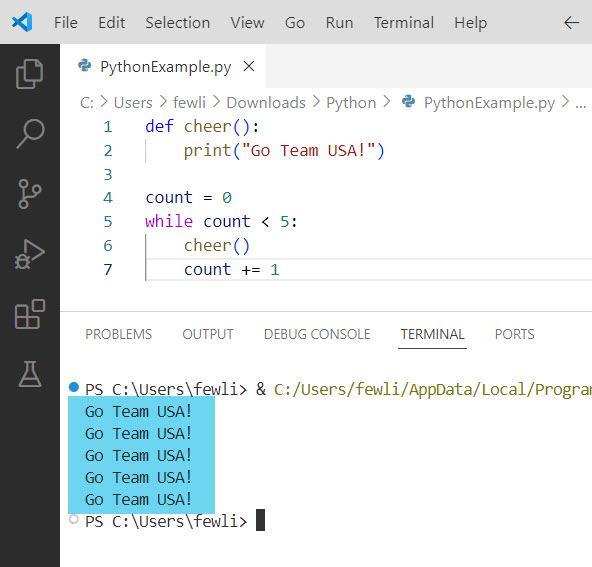
Imagine you have a function that prints “Go Team USA!” and you want to repeat it 5 times.
def cheer():
    print("Go Team USA!")

count = 0
while count < 5:
    cheer()
    count += 1
Here is the output in the screenshot below:
Method 3: Using Recursion
Recursion involves a function calling itself. This method is less common for simple repetition but can be useful in specific scenarios.
Syntax
def repeat_function(n):
    if n > 0:
        function_name()
        repeat_function(n-1)
The function calls itself with a decremented counter until the base condition is met.
Example
Consider a function that prints “Welcome to California!” and you want to repeat it 5 times.
def welcome():
    print("Welcome to California!")

def repeat_welcome(n):
    if n > 0:
        welcome()
        repeat_welcome(n-1)

# Repeat the welcome function 5 times
repeat_welcome(5)
You can see the output in the screenshot below after I executed the above Python code.

Method 4: Using itertools.repeat
The itertools.repeat function is a part of Python’s itertools module and provides a more advanced way to repeat a function.
Syntax
from itertools import repeat

for _ in repeat(None, n):
    function_name()
The repeat function generates an iterator that returns the same value (None in this case) a specified number of times.
Example
Suppose you have a function that prints “Enjoy your meal!” and you want to repeat it 5 times.
from itertools import repeat

def enjoy_meal():
    print("Enjoy your meal!")

# Repeat the enjoy_meal function 5 times
for _ in repeat(None, 5):
    enjoy_meal()
Method 5: Using Threading for Concurrent Repetition
If you need to repeat a function concurrently, you can use Python’s threading module.
Syntax
import threading

def function_name():
    # Function code

threads = []
for i in range(n):
    t = threading.Thread(target=function_name)
    t.start()
    threads.append(t)

for t in threads:
    t.join()
This method creates multiple threads, each executing the function concurrently.
Example
Imagine you have a function that prints “Happy 4th of July!” and you want to repeat it 5 times concurrently.
import threading

def celebrate():
    print("Happy 4th of July!")

threads = []
for i in range(5):
    t = threading.Thread(target=celebrate)
    t.start()
    threads.append(t)

for t in threads:
    t.join()
Conclusion
In this tutorial, I have explained how to repeat a function in Python using different methods, such as: using a for loop, while loop, recursion, itertools.repeat, or threading, etc. For each method, I explained its syntax and how to use it with an example. Still have a question? Feel free to leave a comment below.

I’m Michelle Gallagher, a Senior Python Developer at Lumenalta based in New York, United States. I have over nine years of experience in the field of Python development, machine learning, and artificial intelligence. My expertise lies in Python and its extensive ecosystem of libraries and frameworks. Throughout my career, I’ve had the pleasure of working on a variety of projects that have leveraged my skills in Python and machine learning. Read more…